Archives
-
Volume 1 Nomor 1 (2026)
Vol. 1 No. 1 (2026)Editor’s Note
Welcome to the inaugural issue of Jurnal Dura Negara. The landscape of international relations has
undergone rapid and dynamic shifts across various sectors, characterized by the destabilization of
the international free trade system, the War in Ukraine, and the fragility of European security
frameworks. The world is no longer dominated by a single pole (unipolarity); instead, new powers
such as India, Brazil, and Indonesia have emerged as more active global players. Developing
nations are now increasingly vocal in demanding economic justice and refuse to be trapped in a
position of "choosing sides" between the West (US/EU) or the East (China/Russia). Issues once
considered "marginal" have now ascended to the top of national security agendas.
Climate change, for instance, is no longer merely an environmental concern but an existential
threat triggering mass displacement and resource-driven conflicts. Furthermore, with
advancements in information technology, contemporary diplomacy is increasingly geared toward
achieving soft power through public diplomacy.
These emerging phenomena present a significant challenge for International Relations analysts to
conduct rigorous research and document their findings within a scientific journal that is accessible
to all. We are pleased to provide a platform for scientific works in the field of International
Relations through the establishment of Jurnal Dura Negara. It is with great pride and a sense of
responsibility that we present the inaugural edition of this journal. The name "Dura Negara" is
derived from the Balinese language, meaning "foreign lands" or "overseas." This journal is published by the International Relations Department of Udayana University.
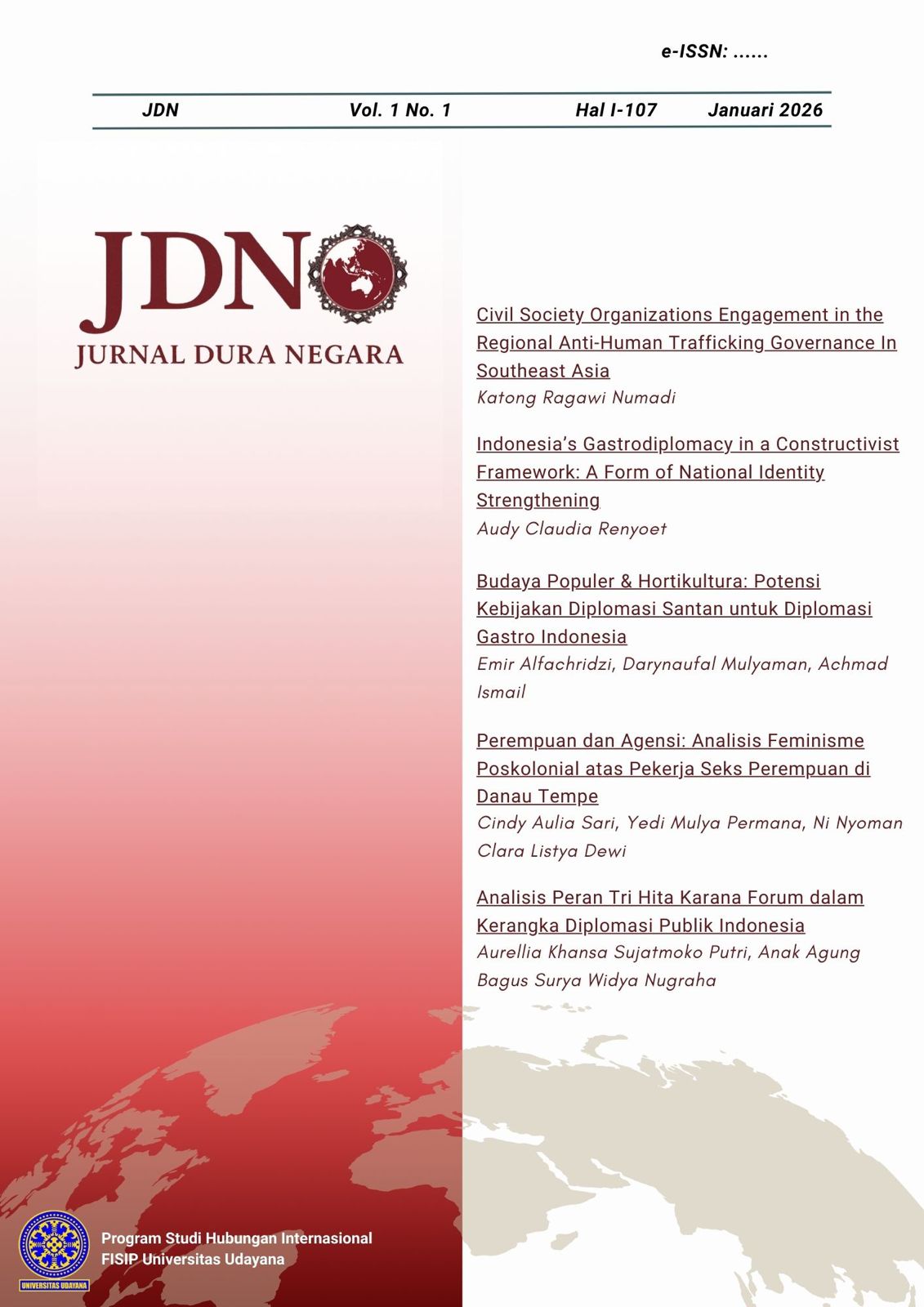
In this first edition, we present academic works on:
1. Civil Society Organizations' Engagement in Regional Anti-Human Trafficking Governance in
Southeast Asia.
2. Indonesia’s Gastrodiplomacy within a Constructivist Framework: A Form of National Identity
Strengthening.
3. Popular Culture & Horticulture: The Potential of "Santan" (Coconut Milk) Diplomacy Policies for
Indonesian Gastrodiplomacy.
4. Women and Agency: A Postcolonial Feminist Analysis of Female Sex Workers in Lake Tempe
(Street).
5. An Analysis of the Role of the Tri Hita Karana Forum within the Framework of Indonesian Public
Diplomacy.
We wish to express our deepest appreciation and gratitude to the founding Editorial Board,
reviewers, and the authors who have entrusted their finest work to this new platform.
I Made Anom Wiranata
Editor-in-Chief