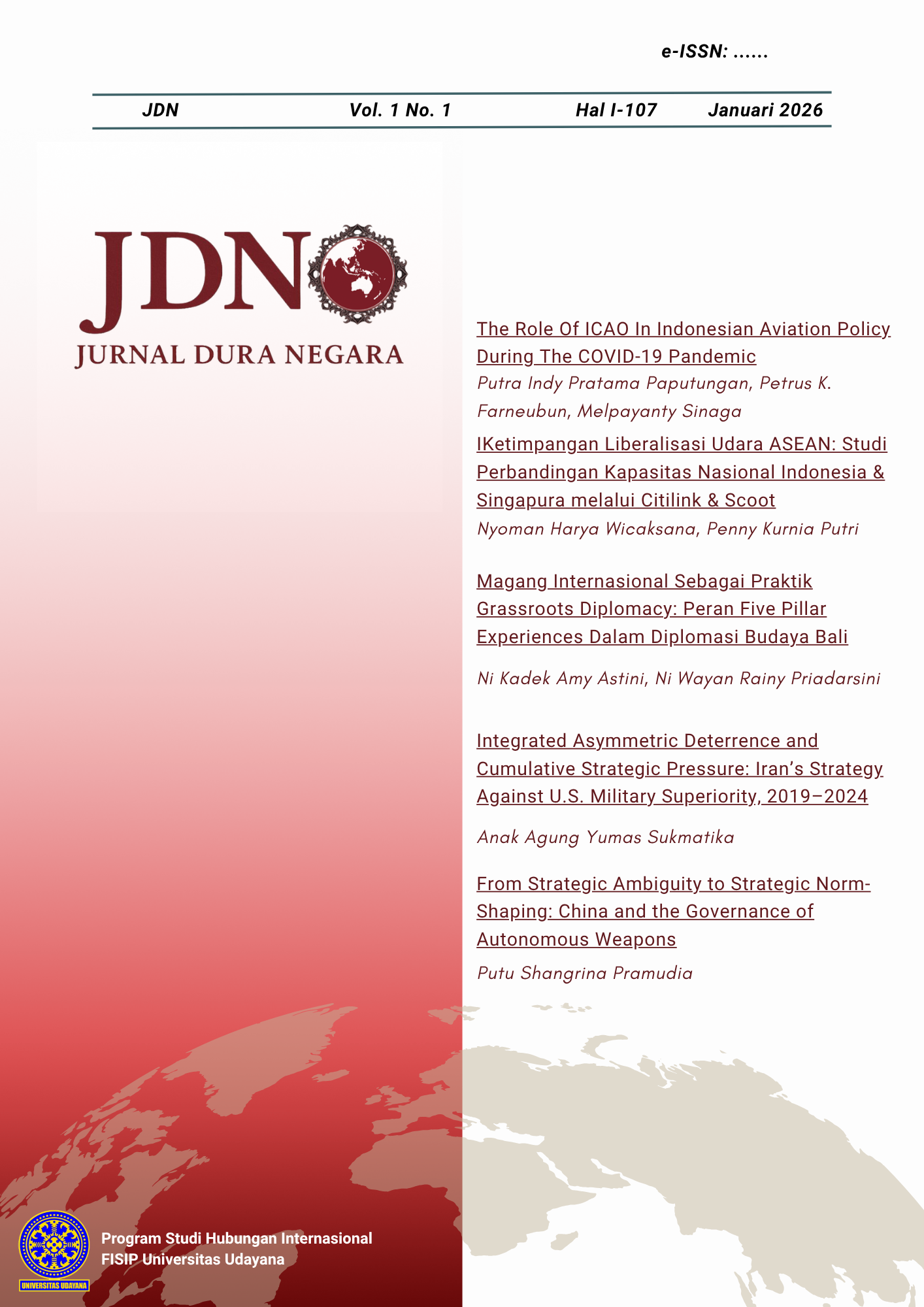
FROM STRATEGIC AMBIGUITY TO STRATEGIC NORM-SHAPING: CHINA AND THE GOVERNANCE OF AUTONOMOUS WEAPONS
DOI:
https://doi.org/10.24843/JDN.2026.v01.i02.p05Keywords:
Autonomous Weapons, China, Norm Contestation, Strategic Ambiguity, Strategic Norm-Shaping, Artificial IntelligenceAbstract
The development of autonomous weapon systems has created growing humanitarian, legal, and strategic concerns, yet international regulation remains contested. China occupies a distinctive position in this debate because it supports restrictions on autonomous weapons while continuing to develop military artificial intelligence and autonomous capabilities. This article examines how and why China’s strategic ambiguity evolved into strategic norm-shaping between 2022 and 2025. It employs a qualitative case-study approach combining process tracing and interpretive content analysis. The study analyses Chinese position papers, official statements at the United Nations, submissions to UN reports, General Assembly resolutions, voting and sponsorship records, and policy documents on military AI. The findings show that China has become more active in shaping definitions, regulatory categories, negotiation conditions, and institutional procedures. China accepts broad principles such as human responsibility and compliance with international humanitarian law, but contests how these principles should be applied. It rejects a blanket prohibition, distinguishes between acceptable and unacceptable systems, and supports a legally binding instrument only under specific procedural conditions. The article concludes that China’s earlier substantive ambiguity has evolved into procedural strategic ambiguity. This enables China to participate in international regulation while preserving military-technological flexibility and influencing the emerging governance framework.
Downloads
Downloads
Published
Issue
Section
License
Copyright (c) 2026 JURNAL DURA NEGARA

This work is licensed under a Creative Commons Attribution 4.0 International License.