Implementasi Fuzzy PID untuk Pengendalian Sudut Pitch pada Pesawat Tanpa Awak
DOI:
https://doi.org/10.24843/MITE.2026.v25.01.p11Keywords:
UAV; Fuzzy PID; Pitch Control; Attitude Control.Abstract
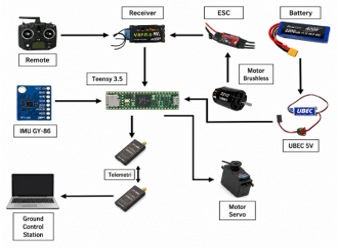
Kestabilan sikap terbang (attitude control) pada pesawat tanpa awak (Unmanned Aerial Vehicle/UAV), khususnya pada sumbu pitch, merupakan aspek penting yang menentukan keberhasilan sistem penerbangan. Pengendali Proportional Integral Derivative (PID) konvensional dengan parameter tetap memiliki keterbatasan dalam menghadapi karakteristik sistem yang bersifat nonlinier dan gangguan eksternal, sehingga berpotensi menghasilkan respons yang lambat, overshoot, dan osilasi. Penelitian ini bertujuan mengimplementasikan pengendali Fuzzy PID berbasis inferensi Mamdani untuk melakukan penalaan (auto-tuning) parameter , , dan secara adaptif pada sistem kendali sudut pitch pesawat tanpa awak tipe FT-Explorer. Sistem diimplementasikan menggunakan mikrokontroler Teensy 3.5 dengan masukan berupa error dan delta error, serta menggunakan basis aturan (rule base) sebanyak 49 aturan (7x7) dan metode weighted average pada proses defuzzifikasi. Evaluasi dilakukan melalui pengujian terbang dan dibandingkan dengan pengendali PID konvensional berdasarkan parameter overshoot, rise time, settling time, dan steady-state error. Hasil pengujian menunjukkan bahwa pengendali Fuzzy PID menghasilkan rise time sebesar 0,8 detik, overshoot sebesar 3,14°, settling time sebesar 3,3 detik, dan steady-state error sebesar 0,24°, lebih baik dibandingkan PID konvensional yang menghasilkan rise time 2,5 detik, overshoot 5,19°, settling time 7,7 detik, dan steady-state error −0,90°. Hasil tersebut menunjukkan bahwa Fuzzy PID mampu meningkatkan kecepatan respons, kestabilan, dan kemampuan adaptasi sistem sehingga lebih efektif diterapkan pada pengendalian sudut pitch pesawat tanpa awak.
.
Downloads
References
[1] E. Ryzty, “Pengembangan Mini Drone Berbasis ESP32 dengan Roll dan Pitch Control Menggunakan Algoritma PID,” Electr. J. Rekayasa Dan Teknol. Elektro, vol. 18, no. 2, pp. 171–182, May 2024, doi: 10.23960/elc.v18n2.2597.
[2] A. Jayadi, T. Susanto, and F. D. Adhinata, “Sistem Kendali Proporsional pada Robot Penghindar Halangan (Avoider) Pioneer P3-DX,” Maj. Ilm. Teknol. Elektro, vol. 20, no. 1, p. 47, Mar. 2021, doi: 10.24843/MITE.2021.v20i01.P05.
[3] T. Susanto and S. Ahdan, “Pengendalian Sikap Lateral Pesawat Flying wing Menggunakan Metode LQR,” PRotek J. Ilm. Tek. Elektro, vol. 7, no. 2, pp. 99–103, Sep. 2020, doi: 10.33387/protk.v7i2.2034.
[4] T. Susanto, “Pengendalian Sudut Pitch dan Roll Pesawat Flying Wing,” Maj. Ilm. Teknol. Elektro, vol. 21, no. 2, p. 303, Dec. 2022, doi: 10.24843/MITE.2022.v21i02.P19.
[5] Oktaf Agni Dhewa, Fatchul Arifin, Ardy Seto Priyambodo, Anggun Winursito, and Yasir Mohd. Mustafa, “Attitude UAV Stability Control Using Linear Quadratic Regulator-Neural Network (LQR-NN),” IIUM Eng. J., vol. 25, no. 2, pp. 246–265, Jul. 2024, doi: 10.31436/iiumej.v25i2.3119.
[6] A. E. Onuora, C. C. Mbaocha, P. C. Eze, and V. C. Uchegbu, “Unmanned Aerial Vehicle Pitch Optimization for Fast Response of Elevator Control System,” . ISSN, vol. 2, no. 3.
[7] T. K. Priyambodo, O. A. Dhewa, and T. Susanto, “Model of Linear Quadratic Regulator (LQR) Control System in Waypoint Flight Mission of Flying Wing UAV”.
[8] M. Shi, “Application of PID Control Technology in Unmanned Aerial Vehicles,” Appl. Comput. Eng., vol. 96, no. 1, pp. 24–30, Nov. 2024, doi: 10.54254/2755-2721/96/20241327.
[9] M. A. Abdelghany, A. Okasha Elnady, and S. O. Ibrahim, “Optimum PID Controller with Fuzzy Self-Tuning for DC Servo Motor,” J. Robot. Control JRC, vol. 4, no. 4, pp. 500–508, Jul. 2023, doi: 10.18196/jrc.v4i4.18676.
[10] Y. A. Admas, H. M. Mitiku, A. O. Salau, C. O. Omeje, and S. L. Braide, “Control of a fixed wing unmanned aerial vehicle using a higher-order sliding mode controller and non-linear PID controller,” Sci. Rep., vol. 14, no. 1, p. 23139, Oct. 2024, doi: 10.1038/s41598-024-73901-y.
[11] A. Baharuddin and M. A. M. Basri, “Self-Tuning PID Controller for Quadcopter using Fuzzy Logic,” Int. J. Robot. Control Syst., vol. 3, no. 4, pp. 728–748, Oct. 2023, doi: 10.31763/ijrcs.v3i4.1127.
[12] M. Samuel, K. Yahya, H. Attar, A. Amer, M. Mohamed, and T. A. Badmos, “Evaluating the Performance of Fuzzy-PID Control for Lane Recognition and Lane-Keeping in Vehicle Simulations,” Electronics, vol. 12, no. 3, p. 724, Feb. 2023, doi: 10.3390/electronics12030724.
[13] D. Jha, A. Ahmed, S. Kumar, and D. Roy, “Fuzzy-PID and interpolation: a novel synergetic approach to process control,” Int. J. Optim. Control Theor. Appl. IJOCTA, vol. 14, no. 4, pp. 355–364, Oct. 2024, doi: 10.11121/ijocta.1483.
[14] “Innovative Fuzzy PID Algorithm: Advancing Quadcopter Control with Adaptive Precision,” Acad. J. Comput. Inf. Sci., vol. 7, no. 2, 2024, doi: 10.25236/AJCIS.2024.070204.
[15] E. Kuantama, T. Vesselenyi, S. Dzitac, and R. Tarca, “PID and Fuzzy-PID Control Model for Quadcopter Attitude with Disturbance Parameter,” Int. J. Comput. Commun. Control, vol. 12, no. 4, p. 519, Jun. 2017, doi: 10.15837/ijccc.2017.4.2962.
[16] D. A. Maulina and M. Mardlijah, “Implementation of Fuzzy-PID Controller on Quadcopter Movement,” Int. J. Comput. Sci. Appl. Math., vol. 10, no. 2, p. 81, Oct. 2024, doi: 10.12962/j24775401.v10i2.21949.
[17] B. Setiawan, D. Widiatmoko, I. Siradjuddin, S. Adhisuwignjo, F. Ronilaya, and M. Syafaat, “Glidding system for a fixed wing aircraft using PID control algorithm,” J. Phys. Conf. Ser., vol. 1402, no. 4, p. 044020, Dec. 2019, doi: 10.1088/1742-6596/1402/4/044020.
[18] R. Ruan and X. Sheng, “Data Modeling and Fuzzy PID Control of Air Pressure Control System,” in 2024 11th International Forum on Electrical Engineering and Automation (IFEEA), Shenzhen, China: IEEE, Nov. 2024, pp. 998–1003. doi: 10.1109/IFEEA64237.2024.10878779.
[19] A.-T. Nguyen, T. Taniguchi, L. Eciolaza, V. Campos, R. Palhares, and M. Sugeno, “Fuzzy Control Systems: Past, Present and Future,” IEEE Comput. Intell. Mag., vol. 14, no. 1, pp. 56–68, Feb. 2019, doi: 10.1109/MCI.2018.2881644.
[20] E. Kuantama, T. Vesselenyi, S. Dzitac, and R. Tarca, “PID and Fuzzy-PID Control Model for Quadcopter Attitude with Disturbance Parameter,” Int. J. Comput. Commun. Control, vol. 12, no. 4, p. 519, Jun. 2017, doi: 10.15837/ijccc.2017.4.2962.
[21] J. P. Sembiring, F. Rossi, and T. Susanto, “Kendali Sudut Pitch dan Roll fase Lepas Landas pada Pesawat VTOL-plane,” Maj. Ilm. Teknol. Elektro, vol. 21, no. 1, p. 35, Jul. 2022, doi: 10.24843/MITE.2022.v21i01.P06.
[22] H. Bolandi, M. Rezaei, R. Mohsenipour, H. Nemati, and S. M. Smailzadeh, “Attitude Control of a Quadrotor with Optimized PID Controller,” Intell. Control Autom., vol. 04, no. 03, pp. 335–342, 2013, doi: 10.4236/ica.2013.43039.
[23] H. Sun, C. Liu, S. Tang, and T. Suo, “Adaptive PID Control of UAV Variable-Pitch Propellers Based on Lightweight Neural Networks,” IEEE Access, vol. 14, pp. 3386–3401, 2026, doi: 10.1109/ACCESS.2025.3648468.
Downloads
Published
Issue
Section
License
Copyright (c) 2026 Try Susanto, Jihad Caesar Pratama (Author)

This work is licensed under a Creative Commons Attribution 4.0 International License.
Jurnal MITE 1 (Majalah Ilmiah Teknologi Elektro) Universitas Udayana menggunakan lisensi akses terbuka Creative Commons Attribution 4.0 International (CC BY 4.0 International).