CASCARA (Clean Aquatic Surface Collector And Robotic Assistant) with Solar Panel Utilization and Remote Control System Equipped with Conveyor
DOI:
https://doi.org/10.24843/MITE.2026.v25.01.p07Keywords:
Kapal; Sampah; Conveyor; Panel surya; Remote Control; Load Cell; TDS sensorAbstract
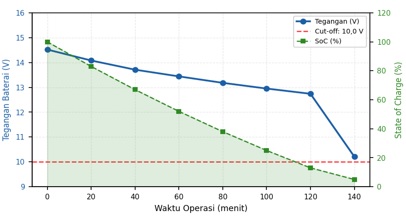
Floating inorganic waste in surface waters such as rivers, lakes, and reservoirs remains a challenging environmental problem. This study aims to design and evaluate CASCARA (Clean Aquatic Surface Collector and Robot Asistant) as a surface waste collection boat utilizing solar panels and a remote control system. The research method includes a literature review, boat design and fabrication, system integration, and operational testing. The boat is equipped with a conveyor for waste collection, a load cell sensor to monitor waste load, a TDS sensor to observe water quality, and a remote control system for operation. Testing was conducted in calm lake conditions and reservoir areas with low water flow. The results show that the boat can accommodate waste loads up to 20 kg, while the load cell sensor achieved an average error of 0.59% with R² = 0.9998, the TDS sensor produced stable readings with an average of 317.4 ppm, and the LiFePO₄ battery system operated for 138 minutes with 94.3% efficiency. Furthermore, the boat achieved a stable RF control range of 82 m, maximum range of 105 m, travel distance of approximately 5.1 km per charging cycle, and real-time IoT monitoring accuracy of 99.4%, indicating that CASCARA can operate effectively and sustainably for low-flow aquatic waste cleaning applications.
Downloads
References
[1] Nurmaya Tri Banowati, “Kelimpahan Mikroplastik Pada Air Dan Biota Laut Di Perairan Pesisir Kota Bandar Lampung,” 2024.
[2] S. Gupta, M. Kohli, R. Kumar, and S. Bandral, “IoT Based Underwater Robot for Water Quality Monitoring,” in IOP Conference Series: Materials Science and Engineering, IOP Publishing Ltd, Jan. 2021. doi: 10.1088/1757-899X/1033/1/012013.
[3] theoceancleanup.com, “The Interceptor: River Cleanup System. The Ocean Cleanup Report.,” theoceancleanup.com.
[4] H. C. Chang, Y. L. Hsu, S. S. Hung, G. R. Ou, J. R. Wu, and C. Hsu, “Autonomous water quality monitoring and water surface cleaning for unmanned surface vehicle,” Sensors (Switzerland), vol. 21, no. 4, pp. 1–21, Feb. 2021, doi: 10.3390/s21041102.
[5] J. Zhu, Y. Yang, and Y. Cheng, “SMURF: A Fully Autonomous Water Surface Cleaning Robot with A Novel Coverage Path Planning Method,” J. Mar. Sci. Eng., vol. 10, no. 11, Nov. 2022, doi: 10.3390/jmse10111620.
[6] P. Desinfektan and A. Azis, “Penerapan Pembangkit Listrik Tenaga Surya pada Robot,” Proceding Seminar Nasional Kewirausahaan, vol. 2, no. 1, pp. 368–374, 2021, doi: 10.30596%2Fsnk.v2i1.8285.
[7] M. Omamageswari, A. Mohanraj, S. C. Jeeva, A. K. Reddy, K. Thilagam, and U. Penchalaiah, “IoT based smart drainage monitoring and cleaning system for solid waste materials,” in Materials Today: Proceedings, Elsevier Ltd, 2021, pp. 2929–2933. doi: 10.1016/j.matpr.2020.11.940.
[8] A. Zafi, D. Saputra, and A. Bianto, “The Monitoring System For Water Quality is Based On The Internet of Things (IoT) And Uses A TDS Sensor,” 2024, doi: 10.3804/ijenset.v1i2.1015.
[9] F. R. Saputra and M. Rivai, “Autonomous Surface Vehicle sebagai Alat Pemantau Lingkungan Menggunakan Metode Navigasi Waypoint,” Jurnal Teknik ITS, vol. 7, no. 1, Mar. 2018, doi: 10.12962/j23373539.v7i1.28493.
[10] Shikhar Shukla, Aman Chauhan, Sonal Singh, and Mr. Kamaleshwar Dhar Dwivedi, “IOT Controlled Water Trash Collector Boat,” Int. J. Sci. Res. Sci. Eng. Technol., vol. 12, no. 3, pp. 394–401, May 2025, doi: 10.32628/ijsrset251247.
[11] Widia Kamisah, Rahmaniar, and Yoffi Andinata, “Analysis of the Efficiency of Solar Power Plants (PLTS) Against Solar Irradiation Using a Solar Power Meter,” vol. 12, pp. 189–194, Dec. 2023.
[12] S. V. Awari, S. V. Pulate, and S. D. Gadakh, “A Review on IoT-Based River Surface Cleaning Robots for Aquatic Waste Management,” International Journal of Advanced Research in Science, Communication and Technology International Open-Access, Double-Blind, Peer-Reviewed, Refereed, Multidisciplinary Online Journal, vol. 5, no. 6, 2025, doi: 10.48175/568.
[13] W. Chen et al., “The Mobile Water Quality Monitoring System Based on Low-Power Wide Area Network and Unmanned Surface Vehicle,” Wirel. Commun. Mob. Comput., vol. 2021, 2021, doi: 10.1155/2021/1609612.
[14] M. Elkolali et al., “A LOW-COST WAVE/SOLAR POWERED UNMANNED SURFACE VEHICLE.”
[15] P. Sharma, K. Srinivasan, M. M. Azizan, K. Hasikin, A. Salwa, and M. Khairuddin, “An automated solid waste detection using the optimized YOLO model for riverine management.”
[16] D. Park et al., “Development of an Autonomous Cleaning Robot with a Hydraulic Manipulator Arm for the Cleaning of Niche Areas of a Ship Hull,” J. Mar. Sci. Eng., vol. 11, no. 5, May 2023, doi: 10.3390/jmse11050973.
[17] M. Dwi Irtanti, L. Rukisna, and universitas Riau, “Kebijakan Pengelolaan Sampah Plastik Sebagai Solusi Pertumbuhan Ekonomi Ramah Lingkungan,” 2026.
[18] P. Sistem et al., “PERANCANGAN SISTEM KONVEYOR PEMBERSIH SAMPAH PADA SALURAN AIR DENGAN MENGGUNAKAN TENAGA AIR,” 2021.
[19] D. Ji et al., “Design and development of autonomous robotic fish for object detection and tracking,” Int. J. Adv. Robot. Syst., vol. 17, no. 3, May 2020, doi: 10.1177/1729881420925284.
[20] S. V. Awari, S. V. Pulate, and S. D. Gadakh, “A Review on IoT-Based River Surface Cleaning Robots for Aquatic Waste Management,” International Journal of Advanced Research in Science, Communication and Technology International Open-Access, Double-Blind, Peer-Reviewed, Refereed, Multidisciplinary Online Journal, vol. 5, no. 6, 2025, doi: 10.48175/568.
Downloads
Published
Issue
Section
License
Copyright (c) 2026 Mawarita Salsabila, Muhammad Sanda Prayoga, Rifki Hadi Purnama, Mochammad Wirangga Syahputra, Albert Gifson Hutajulu (Author)

This work is licensed under a Creative Commons Attribution 4.0 International License.
Jurnal MITE 1 (Majalah Ilmiah Teknologi Elektro) Universitas Udayana menggunakan lisensi akses terbuka Creative Commons Attribution 4.0 International (CC BY 4.0 International).