Sistem Deteksi Lokasi Kebocoran Pipa Distribusi Air Menggunakan Analisis Pola Aliran Multi-Node Berbasis Protokol MQTT
DOI:
https://doi.org/10.24843/MITE.2026.v25.01.p03Keywords:
Leak detection; IoT; flow sensor; ESP32; MQTT; water distribution; pipeline monitoringAbstract
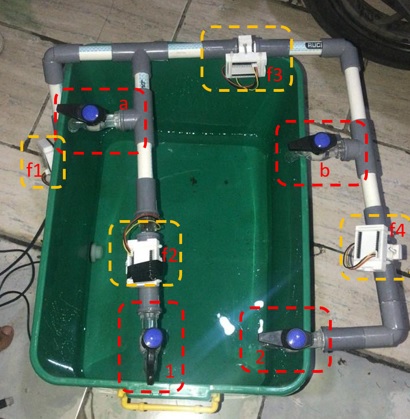
This preliminary study presents a prototype of an Internet of Things (IoT)-based leak detection system for water distribution pipelines. Water loss in conventional networks can reach 20–50% due to delayed response. This research aims to design a prototype that monitors flow rate patterns from multiple pipeline points to identify leak locations based on deviations from normal flow. The system integrates ESP32 microcontrollers and flow sensors across four nodes, transmitting data in real-time to a PHP-based graphical interface via the MQTT protocol. Controlled experiments were conducted using a small-scale prototype with two simulated leak points. Unlike conventional systems that solely rely on monitoring, this architecture implements a closed-loop control mechanism for automated mitigation. Test results show the system successfully localized leaks with a 100% success rate across 13 simulated scenarios without any false positives. Hydraulic anomalies, characterized by increased flow at the sensor before the leak point (due to pump compensation) and a drastic flow reduction at the sensor after the leak point, proved to be effective localization parameters. Communication system evaluation recorded data transmission operating with <1-second latency and 0% data loss. Furthermore, the automated mechanism successfully executed the pump shutdown command (relay off) within 1-2 seconds after a leak was detected. These results confirm the reliability of the proposed architecture in rapidly minimizing water loss. Future research will focus on field testing, sensor optimization, and the development of predictive models.
Downloads
References
[1] United Nations, “Ensure availability and sustainable management of water and sanitation for all,” 2023. https://sdgs.un.org/goals/goal6 (accessed Jan. 28, 2025).
[2] B. Shehu and F. Nazim, “Clean Water and Sanitation for All: Study on SDGs 6.1 and 6.2 Targets with State Policies and Interventions in Nigeria,” Environ. Sci. Proceeding, vol. 15, no. 1, p. 71, 2022, doi: 10.3390/environsciproc2022015071.
[3] Menteri Riset Teknologi dan Pendidikan Tinggi Republik Indonesia, Peraturan Menteri Riset, Teknologi, dan Pendidikan Tinggi Nomor 38 Tahun 2019 Tentang Prioritas Riset Nasional Tahun 2020-2024, no. 1269. Indonesia, 2019, pp. 1–55. [Online]. Available: https://peraturan.bpk.go.id/Home/Details/140206/permen-ristekdikti-no-38-tahun-2019
[4] S. El-zahab and T. Zayed, “Leak detection in water distribution networks: an introductory overview,” Smart Water, vol. 4, no. 5, pp. 1–23, 2019.
[5] S. Harahap and A. S. Budi, “Sistem Pendeteksi Kebocoran Air Pada Saluran Air Rumah Berbasis IoT Menggunakan Metode K-NN,” J. Pengemb. Teknol. Inf. dan Ilmu Komput., vol. 8, no. 6, pp. 1–7, 2024.
[6] Tridinamika, “Kasus Kebocoran Pipa Air Bawah Tanah Milik PDAM,” 2022. https://tridinamika.com/kasus-kebocoran-pipa-air-bawah-tanah-milik-pdam/ (accessed Jan. 28, 2025).
[7] T. A. Azzahra, “Pipa PAM Jaya di Jakarta Bocor hingga 46%, Kerugian Ditaksir Rp 2,5 T,” 2024. https://news.detik.com/berita/d-6610190/pipa-pam-jaya-di-jakarta-bocor-hingga-46-kerugian-ditaksir-rp-2-5-t (accessed Jan. 28, 2025).
[8] Diskominfo Kota Bandung, “Saluran Pipa Bocor, PDAM Tirtawening Siapkan Truk Air Bersih,” 2024. https://jabarprov.go.id/berita/saluran-pipa-bocor-pdam-tritawening-siapkan-truk-air-bersih-16981 (accessed Jan. 28, 2025).
[9] M. I. Mohd Ismail et al., “A review of vibration detection methods using accelerometer sensors for water pipeline leakage,” IEEE Access, vol. 7, pp. 51965–51981, 2019, doi: 10.1109/ACCESS.2019.2896302.
[10] A. Ayadi, O. Ghorbel, M. S. BenSalah, and M. Abid, “A framework of monitoring water pipeline techniques based on sensors technologies,” J. King Saud Univ. - Comput. Inf. Sci., vol. 34, no. 2, pp. 47–57, 2022, doi: 10.1016/j.jksuci.2019.12.003.
[11] Z. Xu, H. Liu, G. Fu, Y. Zeng, and Y. Li, “Feature selection of acoustic signals for leak detection in water pipelines,” Tunn. Undergr. Sp. Technol., vol. 152, no. July, p. 105945, 2024, doi: 10.1016/j.tust.2024.105945.
[12] E. E. Atojunere and G. E. Amiegbe, “Automated Leak and Water Quality Detection System for Piped Water Supply,” Malaysian J. Sci., vol. 43, no. 3, pp. 98–108, 2024, doi: 10.22452/mjs.vol43no3.11.
[13] R. Liu, T. Zayed, and R. Xiao, “Advanced acoustic leak detection in water distribution networks using integrated generative model,” Water Res., vol. 254, no. October 2023, p. 121434, 2024, doi: 10.1016/j.watres.2024.121434.
[14] P. Guo et al., “Leak detection in water supply pipeline with small-size leakage using deep learning networks,” Process Saf. Environ. Prot., vol. 191, no. PB, pp. 2712–2724, 2024, doi: 10.1016/j.psep.2024.10.011.
[15] E. Farah and I. Shahrour, “Water Leak Detection: A Comprehensive Review of Methods, Challenges, and Future Directions,” Water (Switzerland), vol. 16, no. 20, p. 2975, 2024, doi: 10.3390/w16202975.
[16] W. A. Al-ammari, A. K. Sleiti, M. Azizur, S. Rezaei-gomari, I. Hassan, and R. Hassan, “Digital twin for leak detection and fault diagnostics in gas pipelines : A systematic review , model development , and case study,” Alexandria Eng. J., vol. 123, no. March, pp. 91–111, 2025, doi: 10.1016/j.aej.2025.03.054.
[17] N. A. M. Yussof and H. W. Ho, “Review of Water Leak Detection Methods in Smart Building Applications,” Buildings, vol. 12, no. 10, p. 1535, 2022.
[18] N. V. S. Korlapati, F. Khan, Q. Noor, S. Mirza, and S. Vaddiraju, “Review and analysis of pipeline leak detection methods,” J. Pipeline Sci. Eng., vol. 2, no. 4, 2022, doi: 10.1016/j.jpse.2022.100074.
[19] H. Siregar, N. A. Pane, and Y. Yuvina, “Rancang Bangun Monitoring Kebocoran Pipa Air Pada Sistem Irigasi Bibit Kelapa Sawit Berbasis Iot,” in Konferensi Nasional Social dan Engineering Politeknik Negeri Medan, 2023, pp. 428–439.
[20] J. W. Tampubolon, A. B. Primawan, and L. Sumarno, “Implementasi Metode Fuzzy Berbasis Arduino Mega 2560 dan Api Telegram untuk Peringatan Kebocoran Pipa,” in Seminar Nasional Teknik Elektro, Sistem Informasi dan Teknik Informatika, 2024, pp. 112–121.
Downloads
Published
Issue
Section
License
Copyright (c) 2026 Diky Zakaria, Mahmudah Salwa Gianti, Hanif Aidil Rachman, Muhamad Rifai Ayatulloh, Farah Aulia Kirana, Aulia Aufa Zahron (Author)

This work is licensed under a Creative Commons Attribution 4.0 International License.
Jurnal MITE 1 (Majalah Ilmiah Teknologi Elektro) Universitas Udayana menggunakan lisensi akses terbuka Creative Commons Attribution 4.0 International (CC BY 4.0 International).